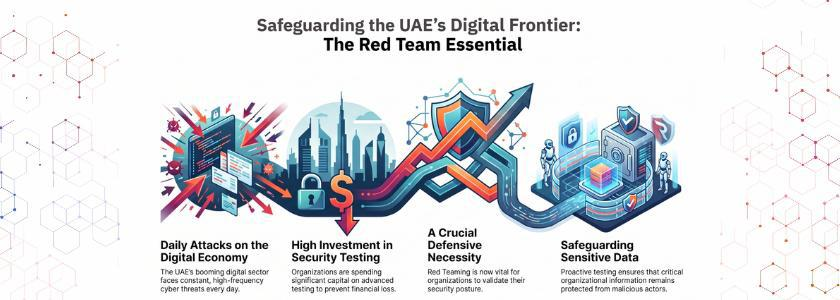
UAE’s booming digital economy is facing many attacks every day. As a result, businesses spend a lot of money on advanced security testing before actual attacks. Red Team in the UAE is crucial for those organizations safeguarding sensitive data.
The attack process mimics real attacks to expose any weaknesses in advance. Thus, knowing how it works is key for making sound security decisions as a leader. To this end, it helps to understand how to use it to make better security decisions as a leader.
Schedule a Call with a Tech Expert
Why Red Team in the UAE Matters for Modern Businesses
The UAE is still attracting investments in the world of finance, tech, and government. Therefore, they become more and more attractive targets for attackers and networks. Unlike traditional Web security audits, Red Team in the UAE uncovers the vulnerabilities that may be overlooked.
Furthermore, this approach is not based on theoretical risk scenarios, but rather is based on the actions of the adversary. This enables businesses to have a realistic picture of their real-world security position. Ultimately, this clarity assists leaders to focus on fixes prior to attackers exploiting them first.
Step-by-Step Process for UAE Businesses
Be sure to follow the steps below to start a business in the UAE:
Step One
All successful engagements begin with proper planning and the scope of the engagement defined. The objectives, targets, and rules of engagement are established in conjunction with the security teams. This helps everyone to “get the word out” about boundaries before test time starts formally.
In the meantime, businesses determine the systems, networks, or facilities that need to be covered in a test. Physical targets and digital targets are frequently a part of the Red Team in the UAE engagements. So, with a clear scope, there is no confusion, and it helps to ensure that important business procedures are in place throughout testing.
Step Two
Then the testers collect data and information about the infrastructure and employees of the target organization. This stage is the same as what “in-the-wild” attackers do before attacking a target. As a result, the testers are able to find vulnerable points of entry, exposed systems, and possible social engineering angles.
Moreover, in this stage the information is made public, which an attacker can easily use. Reconnaissance is the first step in all other steps of the Red Team in the UAE assessments. Thus, extensive research will greatly enhance the effectiveness of simulated attacks.
Step Three
Once testers have conducted reconnaissance, they will try to directly penetrate the organization’s security. This could be a phishing email, exploiting software vulnerabilities, or an attempt to infiltrate physically. Similarly, testers can exploit weak passwords or misconfigured systems for access.
They then come up with a detailed report of the way they got past the existing security measures. This step uncovers today’s exploited vulnerabilities. As such, companies discover exactly how effective or otherwise their initial line of protection is.
Step Four
After entering the network, the testers will penetrate the network deeper and raise their privileges further. This phase mimics an attacker’s actions in gaining further access once the initial access has been achieved. In the meantime, the testers scour for any important data, administrative accounts, or any vital business system.
Red Team assessments in the UAE are carried out with utmost care so as not to cause any damage, and every movement is documented. So, businesses will know just how far a real attacker can go. The knowledge gained from this insight is crucial when it comes to reinforcing internal network segmentation later on.
Step Five
Eventually, testers try to access sensitive databases or other set objectives. At the same time, this stage will see if security teams internally are able to detect the intrusion. As a result, companies discover if their monitoring systems really accomplish the objective of monitoring properly.
Also, in this step, it shows the time taken for responses and communication between the internal employees during real incidents. When detection is slow, it’s an indicator of more serious security issues within a system. This stage provides some of the most important engagement insights, so it is important to make the most of this.
Step Six
Finally, testers will create detailed reports of all the vulnerabilities they’ve found during testing. This report contains specific recommendations to quickly address security vulnerabilities identified. Further, the quality providers report results in easy-to-understand, pertinent business terms.
The UAE Red Team reports should focus on risk according to the potential impact on the business. This makes it easier for leadership teams to prioritize their resources to those most critical fixes first. This last step translates the test results into valuable, enduring security enhancements.
Schedule a Call with a Tech Expert
Why Businesses Should Prioritize Red Team Testing in the UAE
Nothing can be more effective at teaching an organization than a simulated attack. In addition, they help to uncover the way employees react to authentic, unexpected security attacks. Thus, companies create more effective incident response strategies and quicker recovery strategies.
In addition, businesses that test on a regular basis can ensure that they are meeting the ever-changing UAE regulations. In the end, it’s a process that is very beneficial for the reputation, revenue, and customer trust in the long term.
Conclusion
Red Team UAE testing provides a realistic perspective of the vulnerabilities in businesses. As a result, businesses can resolve potential vulnerabilities before any real attackers can take advantage of them. Strengthen defenses over time; each step from planning to reporting strengthens defenses. Accordingly, businesses in the UAE must focus on regular testing to effectively safeguard data, reputation, and operations in 2026.
Frequently Asked Questions
1. How long does a typical red team engagement take to complete?
The majority of engagements are between 2 and 6 weeks long, depending on the scope of the engagement.
2. Does red team testing disrupt normal business operations during testing?
No, very good testers are aware of just how to execute their tests without disturbing the everyday working day business.
3. How often should UAE businesses conduct red team testing?
Experts advise testing once a year for good security. But start-ups and growing businesses should try out the testing more often in the year. Organizations can stay one step ahead of new threats to the network continuously with continuous testing.