
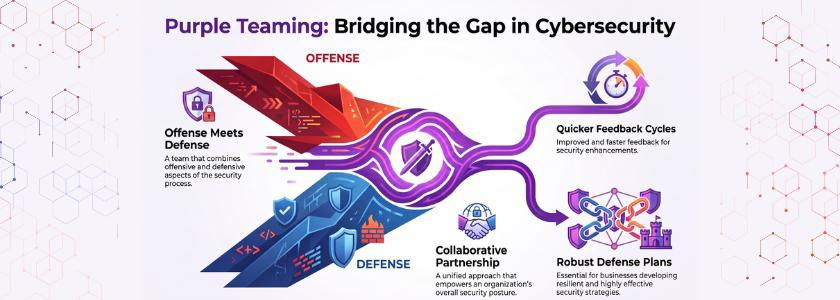
Many organizations now ask a simple but important question directly. What is a purple team in cybersecurity? This information is crucial for businesses in developing robust and resilient defense plans. In cybersecurity, a purple team is a type of team that combines offensive and defensive aspects of the security process. This partnership results in improved and quicker feedback cycles and overall security enhancements. So, businesses have come to invest in that type of model to empower their security posture to a great extent.
Schedule a Call with a Tech Expert
The Core Purpose of a Purple Team in Cybersecurity
At the core of a purple team in cybersecurity is the idea of working together, rather than working against each other. Historically, red teams are the ones to attack, blue teams the ones to defend, and they typically do not work together. But this separation sometimes leads to gaps in communication and to slower learning cycles. However, purple teaming addresses this issue by bringing both groups together to achieve shared objectives.
Thus, both attackers and defenders get real-time insights in each and every test exercise. This constant communication allows defenders to get a real-time understanding of attacker techniques, not after weeks. Furthermore, the red teamers find out what sorts of defenses are effective in actual situations. Consequently, both teams enhance themselves as they go, rather than working independently.
Why Organizations Need This Collaborative Approach
There are numerous companies that spend a lot of money on security solutions without quantifying their effectiveness. In the meantime, this gives a false sense of security against the real cyber threats. In the cybersecurity realm, there is a team that does this, known as a purple team. The exercises also provide insights into certain detection and response weaknesses. Security teams do not make assumptions about what they can achieve; they have solid facts.
Additionally, this information can be used to support leadership decisions with consistent and tangible outcomes for security investment. In the end, businesses have the confidence that they can rely on their defenses in probable situations.
Key Objectives Behind Purple Team Exercises
The main goal is to speed up detection of the systems and to make it more accurate. Likewise, teams use efforts to minimize response times in the event of an incident. A further objective is to certify existing security measures in a real-time environment.
The purple team in cybersecurity identifies staff training gaps, as well. It’s hard for security experts to spot subtle attack patterns promptly without experience. These drills, therefore, are also learning drills for defenders, as the exercises are real-world! In addition, they are leveraged to optimize alerting parameters and decrease alert noise. Fewer false positives means that analysts concentrate their efforts on real threats and dangerous threats.
How Purple Teaming Improves Communication Across Security Functions
The breakdown in communication, usually more so than technical failures, is what is causing security failures. In cybersecurity, such organizational silos are eliminated by a purple team. Attackers are talking about how they’re attacking, defenders are talking about how they’re defending, and both are talking to each other. Both attackers and defenders are talking to each other, both explaining what they are doing.
The transparency assists both groups to get to know one another better. This, in turn, means that decisions on security in the future are more informed and strategically aligned as a whole. Plus, this enhanced communication doesn’t necessarily stop at the security department. Management becomes more aware of the real situation of risks threatening an organization. Thus, enhanced communication equates to smarter and quicker business decisions.
Measuring Success With Purple Team Strategies
The results of this type of penetration testing are not like the traditional penetration testing results. Rather than looking for weaknesses, teams look for gains over the course of multiple tests. A purple team in cybersecurity is used to measure such things as the time taken to detect or the rate of accuracy.
Also, teams track the speed of analysts’ escalation of legitimate threats to leadership. With the passage of time, these metrics can show whether the investments in security have been yielding positive results or not.
In addition, organisations can compare their performance with industry standards and other organisations. It’s a data-driven strategy, eliminating the guesswork from budget planning for cybersecurity completely. Finally, measurable improvement makes for better cases for ongoing investment in security as a company.
Schedule a Call with a Tech Expert
The Long-Term Value of Purple Teaming
It takes time to develop a well-rounded purple team in cybersecurity programs. The long-term benefits help to increase defense and quicker threat response. In addition, the organizations gain knowledge that remains with them even when the employees move on, and the positions change over. This learning is documented, shared, and continually improved during all testing cycles.
In the meantime, businesses that do this may save themselves a significant amount of money in terms of breach expenses. It is so much cheaper to prevent than to recover from big incidents, and to detect them quickly. Thus, purple teaming is not spent money but spent time—the objective being to invest wisely. It’s a model that businesses going forward must consider more seriously if they want to be more mature when it comes to security.
Conclusion
It’s time for cybersecurity to work on offense as well as defense. Collaboration achieves quicker learning and builds more robust, adaptive security instead. The overarching objective remains obvious: attackers and defenders unite toward a common goal of improvement. An organization that adopts this approach will have improved detection and faster response times. In the end, this will turn security from a game of a guessing game to a measurable, continuous improvement.
Frequently Asked Questions
1. How does a purple team differ from red and blue teams?
Red teams exploit systems, and blue teams try to defend against the red team. Purple teaming brings the two groups together and allows for knowledge sharing between them during the entire exercise. This partnership is able to achieve quicker improvements than testing methods that occur in isolation.
2. Is purple teaming suitable for smaller organizations too?
Absolutely, this is a great way to have a collaborative security testing strategy for smaller businesses. If the scale is reduced, then there are still areas of detection gaps and good staff training benefits. Exercises can be comparable to your organization’s size in order to stay cost-effective.
3. How often should companies run purple team exercises?
It’s advisable to run security drills every quarter for steady and measurable security improvement. Certain industries with increased risk, however, can have increased frequency of testing. The frequency of tests should be based on your risk factors.